
False positives have a very particular way of wearing down teams: they don't fail spectacularly, fail in volume. A coincidence that wasn't a coincidence; an alert that repeats with every update; a common name that triggers ten cases in a single shift. Over time, the cost isn't just operational (hours, backlog, rework): it's also a matter of consistency. Two analysts can resolve the same case differently if the criteria aren't well-defined.
Reduce false positives It does not mean loosening controls. Means improve data quality, improve matching y standardize the process so that the decision is defensible. This approach is consistent with the international principle of proportionality to risk (Risk-Based Approach) promoted by the standard of FATF.
Quick summary
A false positive is an alert that appears to be a coincidence, but isn't. It almost always stems from incomplete (or poorly normalized) data and overly "blind" matching rules. You reduce it with three levers: data (better information), rules (better matching logic), and process (better resolution). And you manage it with metrics: if you don't measure noise and time, the backlog returns.
It starts where it hurts the most: the data (not the engine)
When the volume of alerts increases, it's tempting to blame the tool being used. But in most cases, the problem lies in the incoming data: Incomplete capture, different formats, and fields that do not help to differentiate people. In individuals, classic triggers include common names, compound surnames, aliases, changes in order (paternal/maternal), missing birth dates, and blank nationality or country fields. In legal entities, friction usually arises from abbreviated company names., acronym, “SA de CV” in a thousand variations, or corporate groups where several companies share part of the name.
Here's an idea that will save you a lot of frustration: screening rarely fails because no information was found; it fails because he could not rule it out. Therefore, the most profitable operational question is not "how do I lower alerts?", but "what data am I missing to safely rule it out?". OFAC He expresses this practically when he talks about false positives: Don't get stuck on the name, compares against descriptors (date of birth, nationality, identifiers, etc.) to confirm or rule out.
In the financial sector, this typically translates into two quick improvements: defining a minimum KYC capture standard to reduce ambiguity and, secondly, reinforcing data quality at the first point of contact (when corrections are still inexpensive). The same applies, without using those acronyms, if you're validating a critical supplier in Purchasing or a sensitive candidate in HR: If the data doesn't distinguish, neither will the engine..
Rules that do reduce false positives without lowering the standard
The goal is not to make it less sensitive. It's to make it sensitive. smarterThe engine should be demanding where it needs to be and flexible where the data reality demands it. Best practice guides on sanctions screening also recognize this tension: you need effective controls, but with processes and calibration that make the operation viable.
If you want to keep three practical rules (without turning this into a manual), they are these:
- Weigh identifiers when they existIf you have date of birth, country, CURP/RFC or passport (as applicable), use them to strengthen or rule out matches. A name alone is almost never enough.
- Distinguishes “weak coincidence” of “actionable coincidence”A partial match in a common surname should not carry the same weight as a match with a full name + descriptor.
- Control duplicationIf the same profile triggers the same alert with minimal variations, reduce noise with repetition and tracking rules (without deleting evidence).
The crucial point is that these rules don't just exist in the engine: they exist in the criterion of the team. If the tool changes, the logic must remain defensible.
Process: from match to a defensible decision
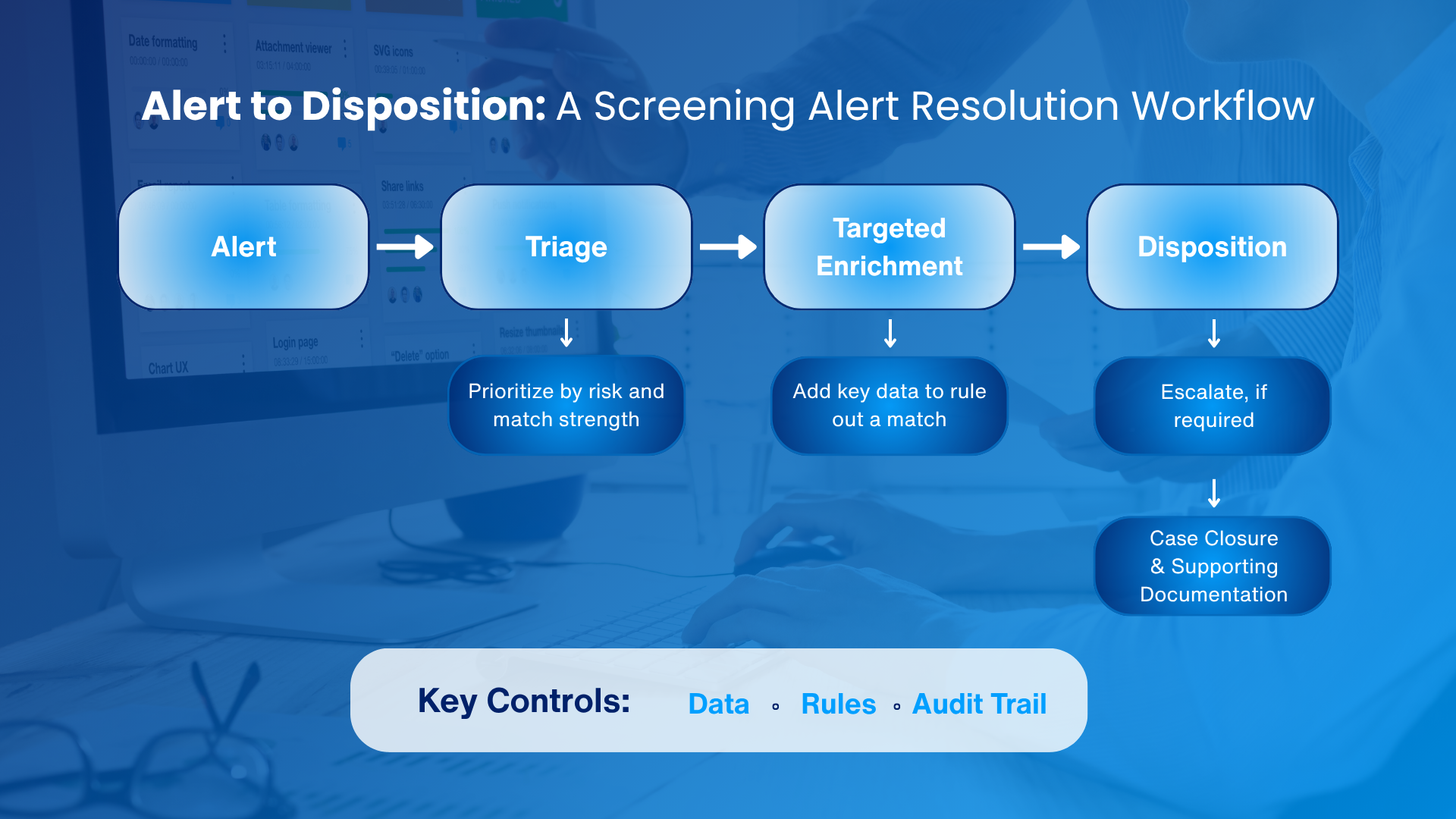
This is where many teams lose the battle, even with good rules. Because a rule without a process generates two queues: the alert queue and the doubt queue. A simple process, on the other hand, ensures that a match quickly becomes one of three possible outcomes: Discard with evidence, escalate with context, either confirm with controls.
Rapid alert classification doesn't have to be complex: it's a classification system to prevent everything from ending up in the same funnel. When you treat all alerts the same, the team learns to survive, not to solve problems. In contrast, when you separate alerts by match quality and customer/operational criticality, effort is better allocated and the times improve.
Next comes the minimum enrichment: it's not about investigating, it's about completing what's necessary to distinguish. Here, discipline is very helpful: if descriptors are missing, the file must state this, and the decision must reflect it (inconclusive, data is requested, monitoring is maintained). This consistency is what protects you from audits and prevents you from reopening cases due to changing criteria.
Metrics that matter: governing noise, time, and consistency
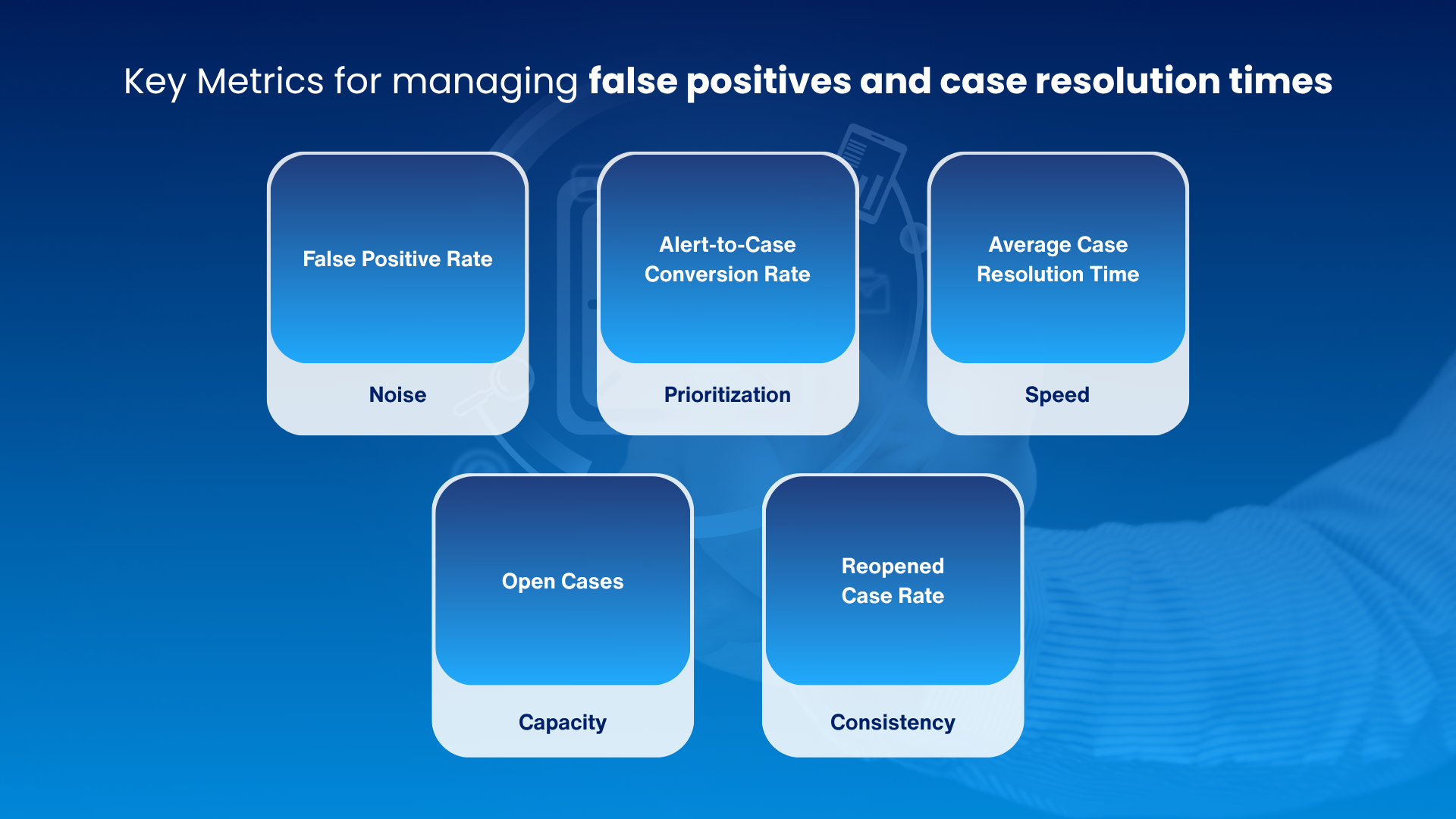
If you don't measure, you only feel. And feeling in PLD/KYC It's dangerous because the volume fluctuates, the list is updated, and the spikes are misleading. The most useful metric isn't always the most elegant: it's the one that connects with the operation.
Think of three questions: How much noise is there?, How long did it take us to resolve it? How consistent was the closure?. The false positive rate and the proportion of alerts that become actual cases tell you about noise. The average resolution time and the backlog tell you about capacity. And the percentage of cases reopened or reversed tells you about consistency. This approach aligns well with the control and effectiveness logic of the international standard (measure and adjust according to risk and operational reality).
Common mistakes
The most expensive mistake is set up Rules without examining the data. The second is measuring only volume (how many alerts) and not measuring quality (how many should be checked). The third is automating decisions without standardizing evidence: you save time today and pay tomorrow with rework, escalation, and inconsistent criteria.
And there's one more, very human one: when the team is overwhelmed, it becomes more tolerant of noise. That's why reducing false positives isn't a technical project; it's an operational governance decision.
In Q-Wise We have been supporting risk mitigation and third-party validation in Mexico for over 30 years. And if there's one thing we've learned in screening, it's this: the problem is rarely a lack of alerts; the problem is having too many unhelpful alerts and not being able to close them consistently.
Next step: get to know the lists and resources that support screening in your operation.
Conclusion
Reducing false positives is a very concrete way to strengthen a program PLD/KYCIt reduces noise, improves efficiency, and, above all, makes decision-making consistent. You don't need magic or absolute promises; you need data-driven discipline, well-thought-out rules, and a process that transforms coincidences into defensible decisions. When that happens, the team stops merely "surviving the queue" and starts to control it.