
When a company checks a customer, supplier, or third party against reference lists, the value of the process lies not only in finding a name. It lies in understanding what that match means, what level of attention it requires, and what evidence should be preserved to support the decision made.
This is important for both financial institutions and companies that are legally required to identify clients or document transactions. Not all sources imply the same thing. Some may require an immediate response; others call for more thorough reviews; and still others simply provide context for better decision-making.
The problem arises when all cases are treated the same. This leads to two costly consequences: disproportionate decisions and weak case files. In other words, either the case escalates more than necessary, or insufficient documentation is provided to explain later what was consulted, when it was done, and how a conclusion was reached.
A coincidence is not a confirmation
In compliance, there is a significant difference between saying “we found a match” and saying “we have a confirmed finding.” This is not a minor detail in wording. That difference defines what is decided, how the case is escalated, and what evidence is retained for an audit, internal review, or committee.
List search, also known in the industry as screening, This involves comparing the names of individuals or companies against public or private sources to identify risk indicators, regulatory obligations, or operational restrictions. But a match is still only the starting point. It could be a homonym, a name variation, incomplete information, or a signal that still needs context.
Therefore, the useful question is not just "does it appear or not?", but "what does that source imply and what comes next?".
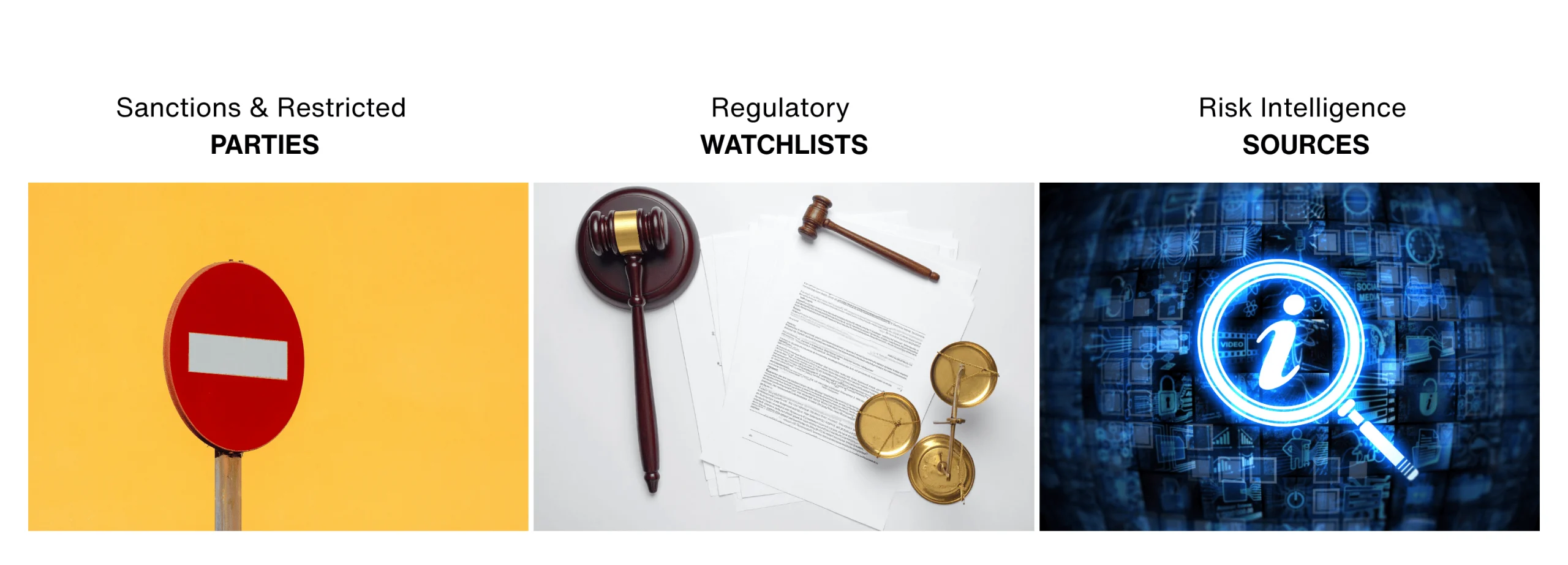
Restrictive sources: when the signal can change the decision
Restrictive sources are those that, by their nature, typically require a more immediate and controlled response. These usually include sanctions lists, international designations, and other instruments that can limit transactions with certain individuals or entities.
In this type of review, a match warrants priority attention. But even here, automatic conclusions must be avoided. Before stopping, rejecting, or escalating a case, it's essential to confirm whether the person or company being reviewed actually matches the record found.
If a team interprets every coincidence as confirmation, it creates operational friction and hasty decisions. If it minimizes it without sufficient analysis, it leaves a control gap that can later be challenged.
Regulatory sources: when demonstrating due diligence is paramount
Regulatory sources typically relate to identification, monitoring, and documentation requirements. The goal here is not always to block a relationship or halt a transaction, but rather to demonstrate that the organization reviewed, analyzed, and made a reasonable decision based on evidence.
In Mexico, a common example is the ecosystem of publications from the Tax Administration Service (SAT) related to the presumption of fictitious transactions, such as the references associated with Article 69-B of the Federal Tax Code. In many internal policies, appearing in these types of publications does not imply an automatic ban, but rather increased due diligence: requesting additional documentation, reviewing the traceability of the business relationship, and adjusting the risk level.
Something similar occurs with politically exposed persons (PEPs). Being a PEP is not a negative conclusion nor proof of wrongdoing. It is a status that, due to exposure and context, often requires enhanced safeguards. The value of the process lies in being able to demonstrate that the review was proportionate and that the final decision was supported.
Information sources: when the signal provides context
Information sources help to better understand a person or company, but on their own they should rarely influence a critical decision without further analysis.
This section may include news articles, reputation alerts, open publications, and other references that suggest further review. Its value lies not in issuing an immediate verdict, but in providing context to help make a better decision.
This point often creates tension within organizations because many departments expect binary answers. However, a serious compliance process rarely operates in black and white. The correct approach is to translate that signal into a defensible conclusion: relevant information exists, further review is conducted, and the decision is supported by the gathered context.
How to document it without making it bureaucratic
When an auditor asks how the checks are performed, they don't usually expect a lengthy explanation. They expect traceability.
This means that if someone reviews the case later, they can understand what source was consulted, when it was consulted, what data was used in the search, and why a particular decision was made.

In practical terms, a well-documented review usually leaves at least four elements: the source consulted, the date of the consultation, the data used for the search, and the decision made with a brief justification.
That doesn't make the process more cumbersome. It makes it reproducible. And when multiple departments are involved or staff changes, that consistency becomes even more important.
It's also worth remembering that the most effective way to reduce inconclusive matches isn't to lower the search sensitivity, but rather to improve identity resolution with additional data. Full company name, date of birth, Federal Taxpayer Registry (RFC), country, address, or other available identifiers can make the difference between a weak match and a more solid conclusion.
The most common mistake: using the same rule for everything
If an information source is treated as if it were a formal constraint, the review becomes excessive. If a constraint is treated as if it were merely context, the review falls short.
In both cases, the problem is not the list itself. The problem is the criteria used to interpret it.
Therefore, a mature process typically follows a simple logic: classify the source, resolve the identity, decide based on risk, and document with proportionate evidence. This sequence helps reduce friction, improve consistency, and support decisions with greater clarity.
Conclusion
Distinguishing between restrictive, regulatory, and informative sources is not a technicality. It is a practical way to make better decisions and support them with evidence.
When an organization can explain what it consulted, why that source mattered, and how it reached its conclusion, list searching ceases to be a reactive step and becomes part of a clearer and more reliable operation.
If the challenge today is that everything seems the same, leading to internal disagreements or weak case files, the most cost-effective adjustment is usually this: better classify sources, align expected responses, and standardize the minimum evidence required. From there, technology ceases to be a temporary fix and begins to accelerate the process.